

The Value of Cultural Values
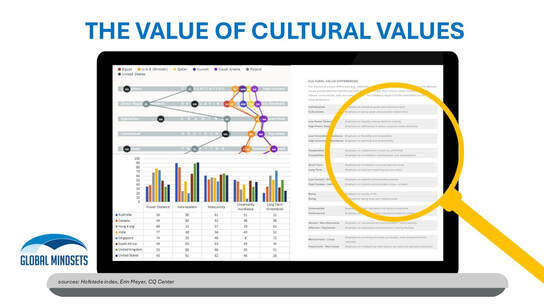
Last week, I had the opportunity to attend a thought-provoking session organized by SIETAR Europe about the value of cultural dimensions.
Cultural dimensions provide a framework for understanding and comparing diverse cultural values that shape and influence various aspects of human interactions at work (and beyond).
The key question that was brought up for discussion was: "Are the dimensions we use for intercultural education and training 'more helpful' or 'more unhelpful'?”
It was very interesting to witness that the responses were a mix of helpful and unhelpful (while some said both).
I can't speak for others, but based on my observations working with the corporate world over the past 15 years, here are my three insights I would like to share about cultural dimensions:
1. Cultural dimensions reflect the REALITY around us.
How do I know this?
From conversations I have had with many clients from various industries and backgrounds who openly share their experiences working in a global business environment.
Most of the time, they are not aware of the terminology we use in research, but when I listen to their stories and observations, I can recognize which cultural dimension the challenge they describe is about (if at all). After all, understanding the cultural values that influence people's behaviours is one of the core pillars of our work as interculturalists.
For instance, when leaders share with me that their team from a specific location lacks initiative behaviours or struggles to solve problems independently, I can hypothesize that this gap in expectations may be related to cultural dimensions of collectivism-individualism or high/low power distance.
2. It’s not about how helpful or unhelpful the tool is, but about how we use it.
One thing to keep in mind is that the purpose of cultural dimensions is not to stereotype individuals or nations but to help understand human behaviours within their cultural contexts.
What we need to do when working with these tools is to use them wisely instead of following them blindly. This is similar to how we use AI tools for writing or Google Maps for driving. If you mindlessly follow Google Maps for navigation without much thought, instead of reaching your destination, you might end up in unexpected places, like a muddy field. And cultural maps work in a very similar way. While they can provide useful guidance, it's important not to rely on them entirely; otherwise, you may get lost.
3. The perceived value depends on where you are in the journey.
Experience is valuable, but sometimes it can lead us to lose sight of the value of things. When I started my professional journey in this field, I found immense value in the research on cultural dimensions. It allowed me to connect my personal work experiences with theories. It’s not surprising that people who discover these dimensions for the first time often find them very insightful and useful at work.
However, if you work with them for many years, you might become more aware of their limitations rather than their value. You could also become so used to them that you may fail to recognize their importance (this could happen with marriage, too! :)
Reflecting on these three insights, my key advice would be to learn to live in harmony with the bright and dark sides of cultural dimensions. And to remember that although they are designed to help us understand the world around us better, these categorizations might also create divisions and lead to separation.
One thing for sure – whether helpful or not, it might be challenging (and even impossible) to have cultural conversations without talking about cultural dimensions.
Do you have mixed feelings about working with cultural dimensions? Feel free to share your observations from working with these tools.
The key question that was brought up for discussion was: "Are the dimensions we use for intercultural education and training 'more helpful' or 'more unhelpful'?”
It was very interesting to witness that the responses were a mix of helpful and unhelpful (while some said both).
I can't speak for others, but based on my observations working with the corporate world over the past 15 years, here are my three insights I would like to share about cultural dimensions:
1. Cultural dimensions reflect the REALITY around us.
How do I know this?
From conversations I have had with many clients from various industries and backgrounds who openly share their experiences working in a global business environment.
Most of the time, they are not aware of the terminology we use in research, but when I listen to their stories and observations, I can recognize which cultural dimension the challenge they describe is about (if at all). After all, understanding the cultural values that influence people's behaviours is one of the core pillars of our work as interculturalists.
For instance, when leaders share with me that their team from a specific location lacks initiative behaviours or struggles to solve problems independently, I can hypothesize that this gap in expectations may be related to cultural dimensions of collectivism-individualism or high/low power distance.
2. It’s not about how helpful or unhelpful the tool is, but about how we use it.
One thing to keep in mind is that the purpose of cultural dimensions is not to stereotype individuals or nations but to help understand human behaviours within their cultural contexts.
What we need to do when working with these tools is to use them wisely instead of following them blindly. This is similar to how we use AI tools for writing or Google Maps for driving. If you mindlessly follow Google Maps for navigation without much thought, instead of reaching your destination, you might end up in unexpected places, like a muddy field. And cultural maps work in a very similar way. While they can provide useful guidance, it's important not to rely on them entirely; otherwise, you may get lost.
3. The perceived value depends on where you are in the journey.
Experience is valuable, but sometimes it can lead us to lose sight of the value of things. When I started my professional journey in this field, I found immense value in the research on cultural dimensions. It allowed me to connect my personal work experiences with theories. It’s not surprising that people who discover these dimensions for the first time often find them very insightful and useful at work.
However, if you work with them for many years, you might become more aware of their limitations rather than their value. You could also become so used to them that you may fail to recognize their importance (this could happen with marriage, too! :)
Reflecting on these three insights, my key advice would be to learn to live in harmony with the bright and dark sides of cultural dimensions. And to remember that although they are designed to help us understand the world around us better, these categorizations might also create divisions and lead to separation.
One thing for sure – whether helpful or not, it might be challenging (and even impossible) to have cultural conversations without talking about cultural dimensions.
Do you have mixed feelings about working with cultural dimensions? Feel free to share your observations from working with these tools.
Comments