

Cultural Intelligence: The Key to Future Skills
When I started working in the intercultural field, I thought the main objective of cultural learning was relatively simple: to help people from different cultural backgrounds work effectively together. While that is still important, over the years I have realised it’s so much more than that.
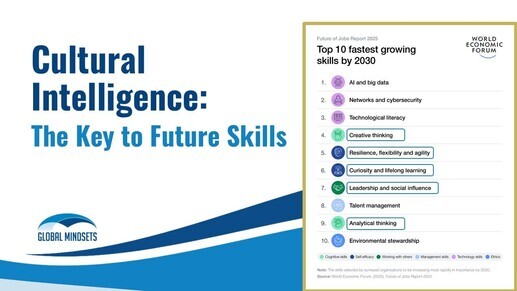
Cultural intelligence (CQ) isn’t just about working effectively across borders - it’s about supporting the development of other key skills needed for today’s and tomorrow’s workplace. In this article, I chose 5 core skills on the rise according to the latest World Economic Forum Future of Jobs Report 2025 and show how high CQ can support the development of each one of them.
1. Creative Thinking 🎨
People with high CQ tend to observe situations from multiple angles, which enhances their creativity. Every time they step into a culture different from their own, they are stretched to think differently and broaden their perspective by asking: “How else can we approach this?” Engaging with different cultures exposes them to diverse norms, values, and problem-solving styles, challenging their assumptions and default ways of thinking.
Over time, they learn to hold several perspectives at once, connect unexpected dots, and generate ideas that others might overlook. When you are constantly comparing, contrasting, and integrating different viewpoints, your mind becomes wired to connect ideas in new ways.
2. Resilience, Flexibility and Agility 💪
People with high CQ tend to be more resilient because they are used to adapting to new environments. Working across cultures constantly exposes them to different expectations and diverse ways of doing things. Instead of resisting, they stay open and adjust their behaviour.
This ongoing adaptation trains them to stay flexible and emotionally strong. They recover quickly from misunderstandings or setbacks and continue moving forward, even in times of uncertainty. They are also more open to experimentation, step beyond their comfort zone, and grow through change.
3. Curiosity and lifelong learning 🔍
When you have high CQ, you don’t stop at “That’s strange”. You dive deeper and ask, “Why is it done that way?” For example, why do people say yes when they mean no or why don’t people follow deadlines? You develop a genuine hunger to understand, and every cross-cultural interaction becomes a learning opportunity about others and about yourself.
Gradually, this constant exploration builds the muscle of curiosity and the desire to learn, unlearn, and relearn. It’s a similar mindset that drives continuous learning and the awareness that knowledge is never complete, especially in times of AI.
4. Leadership & Social Influence 👥
Leaders with high CQ don’t try to inspire and influence everyone in the same way. They recognise that people are moved by different things: some seek harmony, others clarity. Some want autonomy, others guidance and support. Some value directness, others diplomacy.
They know how to build trust differently by understanding the invisible cultural codes, and they are more inclusive by creating spaces where every voice feels heard. This is especially important in today's world, where Leadership is less about authority and more about influence and connection.
5. Analytical Thinking 🧠
Leaders with high CQ constantly refine their analytical thinking because they know that context is everything. By navigating the complexity of global environments, they improve their ability to analyse, interpret, and connect large amounts of information across cultures and markets. This helps them apply different strategies that consider multiple variables.
When it comes to people, they also see beneath the surface by linking observable behaviours to deeper cultural values and noticing nuances that others might miss. This depth of understanding enables them to see patterns and make better decisions, grounded in context rather than “universal” standards.
To summarize
Cultural Intelligence (CQ) doesn’t just help us navigate differences. It’s a strategic capability that strengthens many of the essential skills the future workforce needs.
In my work with global leaders and teams across industries, these are some of the skills they consistently highlight as essential for their success in an increasingly complex world. What do you think? Which other future skills can be strengthened through high CQ? I would love to hear your thoughts.
1. Creative Thinking 🎨
People with high CQ tend to observe situations from multiple angles, which enhances their creativity. Every time they step into a culture different from their own, they are stretched to think differently and broaden their perspective by asking: “How else can we approach this?” Engaging with different cultures exposes them to diverse norms, values, and problem-solving styles, challenging their assumptions and default ways of thinking.
Over time, they learn to hold several perspectives at once, connect unexpected dots, and generate ideas that others might overlook. When you are constantly comparing, contrasting, and integrating different viewpoints, your mind becomes wired to connect ideas in new ways.
2. Resilience, Flexibility and Agility 💪
People with high CQ tend to be more resilient because they are used to adapting to new environments. Working across cultures constantly exposes them to different expectations and diverse ways of doing things. Instead of resisting, they stay open and adjust their behaviour.
This ongoing adaptation trains them to stay flexible and emotionally strong. They recover quickly from misunderstandings or setbacks and continue moving forward, even in times of uncertainty. They are also more open to experimentation, step beyond their comfort zone, and grow through change.
3. Curiosity and lifelong learning 🔍
When you have high CQ, you don’t stop at “That’s strange”. You dive deeper and ask, “Why is it done that way?” For example, why do people say yes when they mean no or why don’t people follow deadlines? You develop a genuine hunger to understand, and every cross-cultural interaction becomes a learning opportunity about others and about yourself.
Gradually, this constant exploration builds the muscle of curiosity and the desire to learn, unlearn, and relearn. It’s a similar mindset that drives continuous learning and the awareness that knowledge is never complete, especially in times of AI.
4. Leadership & Social Influence 👥
Leaders with high CQ don’t try to inspire and influence everyone in the same way. They recognise that people are moved by different things: some seek harmony, others clarity. Some want autonomy, others guidance and support. Some value directness, others diplomacy.
They know how to build trust differently by understanding the invisible cultural codes, and they are more inclusive by creating spaces where every voice feels heard. This is especially important in today's world, where Leadership is less about authority and more about influence and connection.
5. Analytical Thinking 🧠
Leaders with high CQ constantly refine their analytical thinking because they know that context is everything. By navigating the complexity of global environments, they improve their ability to analyse, interpret, and connect large amounts of information across cultures and markets. This helps them apply different strategies that consider multiple variables.
When it comes to people, they also see beneath the surface by linking observable behaviours to deeper cultural values and noticing nuances that others might miss. This depth of understanding enables them to see patterns and make better decisions, grounded in context rather than “universal” standards.
To summarize
Cultural Intelligence (CQ) doesn’t just help us navigate differences. It’s a strategic capability that strengthens many of the essential skills the future workforce needs.
- By learning to see situations from multiple angles, CQ improve creativity.
- By adapting to new environments that demand behavioural change, CQ builds resilience and agility.
- By staying open to differences and eager to understand them, CQ ignites curiosity and lifelong learning.
- By recognising that people are influenced differently, CQ enables leaders to inspire diverse teams and drive high performance.
- By navigating global complexity and context, CQ refines analytical thinking
In my work with global leaders and teams across industries, these are some of the skills they consistently highlight as essential for their success in an increasingly complex world. What do you think? Which other future skills can be strengthened through high CQ? I would love to hear your thoughts.
Comments